

The Truth About Cloud POS: Why Agility Still Feels Out of Reach for Many U.S. Businesses
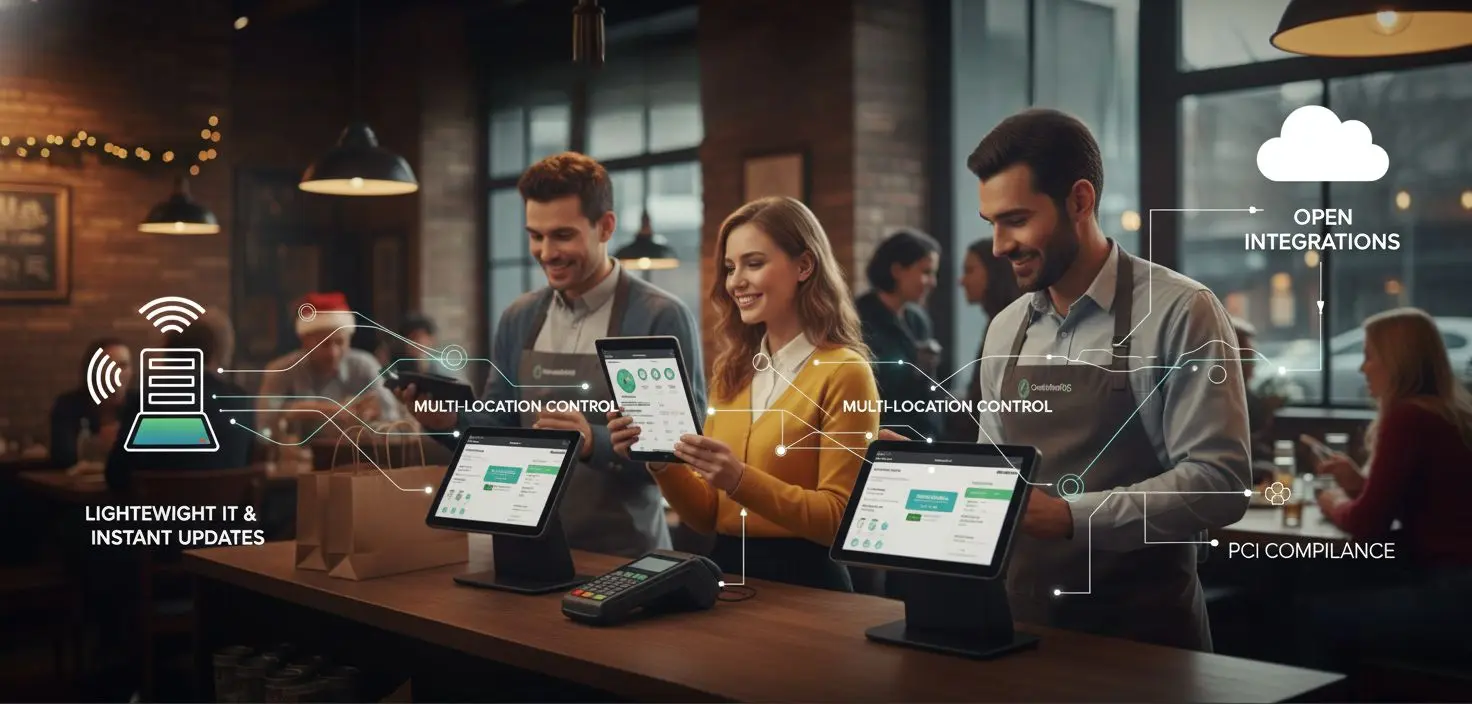
Cloud POS is no longer a “nice-to-have.” It’s the operational backbone for fast menu changes, multi-store inventory, remote management, and modern payments — exactly what U.S. QSRs and liquor stores rely on to stay profitable and responsive.
Why? Because takeouts, speed, and deal-hunting have become default customer behavior. The market is moving fast — double-digit cloud POS growth, rising security expectations, and operators chasing higher throughput and thinner margins.
For POS Users & Owners: Why Cloud POS Matters
Cloud is supposed to make life simpler — push new offers in real time, track every item across locations, and never miss a sale when traffic spikes. It’s the invisible engine behind record sales and data-driven decision-making.
But here’s the question every operator should ask: is your tech upholding its end of the deal?
The Reality Check: Why “Cloud POS” Often Feels… Not So Cloud
1. Offline ≠ Business Continuity

Many systems have “offline modes” that work only on paper — limited duration, restricted functions, and risk pushed to the merchant. When a vendor’s DNS or central server fails, stores stall.
Square’s 14-hour outage in 2023 is a case in point: merchants learned about it on social media while their registers froze.
Net effect: lost sales, manual workarounds, and liability on declined offline transactions — hardly the resilience cloud was meant to deliver.
2. APIs: Gated, Slow, or Paywalled
True cloud agility depends on open, fast integrations. Yet:
- Toast gates write-access behind partner certification and long approval cycles.
- Clover forces merchants into app-store economics for even basic capabilities.
Net effect: slow innovation, mounting monthly costs, and dependency on someone else’s roadmap.
3. Vendor Lock-In by Design
Many platforms bundle payments so tightly that merchants end up paying twice — for processing and subscriptions — while losing control over data portability.
Even Toast’s own S-1 admits API access sits behind premium tiers.
Net effect: fewer choices, higher costs, and a system that owns you, not the other way around.
4. Multi-Store Control That Isn’t
Chain-grade agility — promos by region, bottle-to-case inventory, age-check governance — still eludes most “cloud” vendors. Many rely on plug-ins or expensive customization just to achieve the basics.
Bottom line: Cloud should mean faster changes, richer data, seamless integrations, and minimal hardware fuss. Yet many U.S. merchants only get fragments of that promise.
Too many providers are cloud-washed — limited offline modes, gated APIs, app taxes, and fragile dependencies.
That’s the gap OneHubPOS set out to close.
The 10 Big Advantages of Cloud POS — Explained Simply

1️⃣ Instant Updates
Menu tweaks, happy-hour pricing, or new tax rules — push them live to every register in minutes.
2️⃣ Lower Total Cost of Ownership
No heavy servers or truck-roll maintenance. Android hardware + cloud software keeps setup fast and affordable.
3️⃣ Better Multi-Location Control
Centralize price lists, inventory transfers, and purchase orders — push promos to all stores or just one.
4️⃣ Open Integrations = Faster Innovation
Plug in payments, ecommerce, loyalty, or delivery tools easily — without waiting on vendor approvals.
5️⃣ Data for Decisions
Granular insights on sales, labor, and profit drivers enable smarter scheduling and promo timing.
6️⃣ Resilience & Security
Local failover keeps sales running during internet drops; cloud backups protect against ransomware.
7️⃣ Compliance Clarity (PCI DSS 4.0)
Tokenization and P2PE terminals minimize card-data exposure and simplify merchant compliance.
8️⃣ Speed to New Payments
Adopt tap-to-pay, wallets, or line-busting devices instantly — no hardware refresh cycles.
9️⃣ Lightweight IT
Ship an Android kit, scan a QR code, and start selling. No local servers, no late-night patching.
🔟 Future-Proof for AI
AI tools for forecasting, menu engineering, and fraud detection plug in faster when your POS lives in the cloud.
POS Providers in 2025 — Cloud vs Hybrid
How OneHubPOS Turns Cloud Power into Merchant Wins
The POS industry is crowded with “cloud-washed” claims. Real agility isn’t about where data lives — it’s about how your business performs when things go wrong.
1. Built for Chaos — and Control
Wi-Fi drops? Orders still move, payments still process, and data syncs automatically once back online.
2. Chain-Ready from Day One
Whether two stores or twenty, push pricing, menus, and promos instantly — consistency made effortless.
3. Payments That Don’t Cage You
Choose your processor, control your margins. OneHubPOS plays well with NMI, Dejavoo, PAX, EPX, and more.
4. Promotions That Actually Perform
BOGOs, happy hours, bundles — launch them once and watch them sync everywhere, instantly.
5. Tailored for Liquor & QSRs
Bottle-to-case tracking, age checks, delivery integrations — built natively, not bolted on.
6. Android Simplicity, Enterprise Smarts
Affordable, powerful, and endlessly scalable — no servers, no IT firefighting, no surprises.
In short: where others market “cloud,” OneHubPOS delivers it — fast, flexible, and battle-ready for real-world operations.
Final Word
Cloud POS was meant to democratize agility. Instead, it’s become another buzzword wrapped in contracts and downtime disclaimers.At OneHubPOS, we believe the next wave isn’t just cloud — it’s control in the hands of every merchant. Want to see OneHubPOS in action? Register for a free 30-minute demo today.


Sahana is a seasoned GTM leader with a passion for building startups. She excels in crafting GTM strategies for tech products, driving revenue growth.