

The "No Tax on Tips" Rule: How The One Big Beautiful Act Changes Your 2026 W-2 Reporting for Restaurants and Retail Stores
.png)
Imagine telling your servers they get to keep thousands of dollars more of their hard-earned money this year. The morale boost would be instant. That is exactly what the "No Tax on Tips" provision promises — a financial win for the front-of-house staff who keep your business running.
But for restaurant owners and retail managers, this "beautiful" act comes with a beast of a burden: compliance.
While your staff celebrates the tax cut, your back office is staring down the barrel of the most significant W-2 reporting changes in a decade. "No Tax" doesn't mean "No Paperwork." In fact, for 2026, it means exactly the opposite. If your POS and accounting systems aren't talking to each other, you could be facing a reporting nightmare come tax season.
Here is everything you need to know about the One Big Beautiful Act and how to survive the 2026 reporting shift without losing your mind.
Also Read: 2026 Tax Deadlines You Can Not Afford to Miss [Tax Calendar 2026]
What is the "No Tax on Tips" Rule?
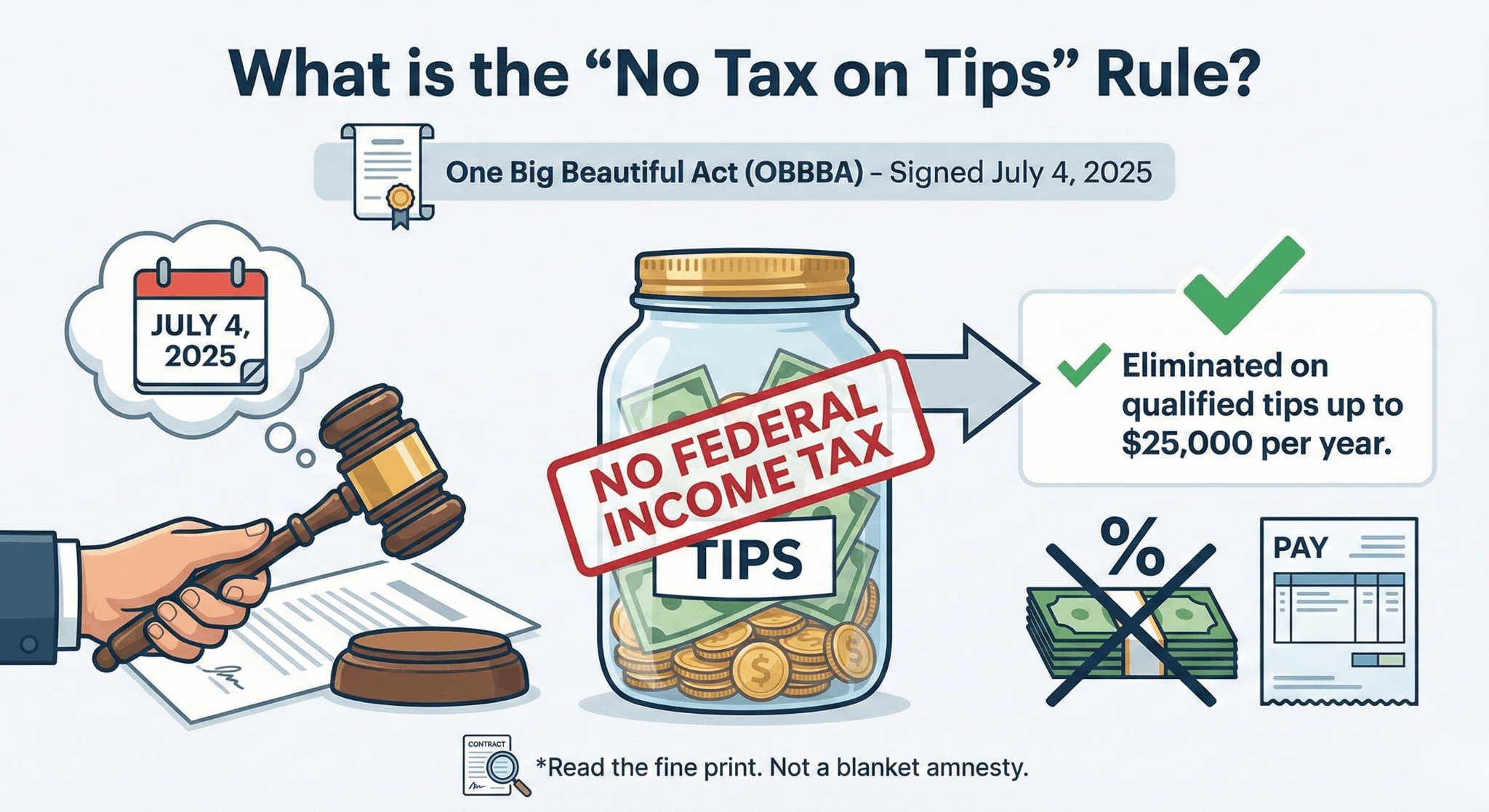
Signed into law on July 4, 2025, as part of the One Big Beautiful Act (OBBBA), this legislation is designed to provide relief to service industry workers.
In simple terms: Federal income tax is eliminated on qualified tips up to $25,000 per year.
This is a massive shift from previous years where every cent of tip income was taxed at the same rate as regular wages. However, it is vital for business owners to read the fine print. This is not a blanket amnesty on all money that changes hands.
The Key Constraints You Must Know:
- Federal Income Tax Only: It is critical to understand that tips are still subject to FICA taxes (Social Security and Medicare). You, as the employer, must still withhold these taxes. The relief applies strictly to Federal Income Tax.
- Voluntary Tips Only: The legislation draws a hard line between a "tip" and a "service charge." Mandatory service charges, auto-gratuities for large parties, or "administrative fees" do not qualify for the tax break.
- Qualified Occupations: The deduction applies only to workers in occupations that "customarily and regularly" receive tips (waiters, bartenders, hairstylists, etc., based on the Treasury's 2024 list).
- Temporary Relief: Currently, this rule is effective for tax years 2025 through 2028.
The Hidden Trap: It Changes Everything for W-2 Reporting
Many business owners assume that if the government isn't taxing it, you don't have to track it. Wrong.
To ensure employees can claim this deduction, the IRS requires employers to validate exactly which tips are "qualified" and which are not. This shifts the burden of proof directly onto your Point of Sale (POS) and accounting tracking.
See Also: How Restaurants Can Use POS Analytics Reports to Stay Ahead
The 2026 W-2 Shake-Up
For the 2026 tax year, the "honor system" is largely gone. Employers are now required to provide a granular breakdown of income. Here is what is changing on your backend:
1. Segregation of "Qualified" vs. "Non-Qualified" Tips
In the past, a tip was a tip. Now, your system needs to distinguish between:
- Voluntary Tips: Cash or credit tips left freely by the customer (Tax-Deductible for the employee).
- Service Charges: Mandatory fees added to the bill (Fully Taxable).
If your POS lumps these together as a single "Gratuity" line item, your employees will lose their tax deduction, and you could face audits for misreporting income. You cannot simply export a raw total at the end of the year anymore; the data needs to be clean from day one.
2. New W-2 Codes and Boxes
While the 2025 tax year is treated as a "transition period" where estimates are allowed, 2026 is mandatory. You should expect to see:
- Separate Reporting: Qualified tips may need to be reported in specific boxes or with new codes to differentiate them from standard wages.
- Validation: You are essentially certifying to the IRS that $X amount of income was "voluntary tip income" eligible for the deduction.
3. The "Overtime" Complexity
The OBBBA also includes a "No Tax on Overtime" provision (deducting the half-time premium). This means your payroll logic must now track multiple distinct buckets of money for a single shift:
- Base Hourly Wage (Taxed)
- Overtime Premium (Deductible)
- Tips (Deductible up to $25k)
Why Generic Systems Will Fail You
Most legacy systems are not built to split "Service Charges" from "Tips" at the data level required for these new W-2s. If you are using an outdated register or a generic retail POS for a restaurant, you might find yourself manually calculating these totals for every employee at the end of the year.
Do you have time to manually audit 52 weeks of shifts for 20 employees to separate auto-grat from cash tips? Probably not.
The operational reality is that the definition of "income" has become more complex. Your technology needs to handle that complexity so you can focus on running your business.
How OneHubPOS Simplifies Compliance
At OneHubPOS, we understand that as a business owner, your priority is efficiency, not wrestling with new tax codes. Our system is designed to handle the nuances of the restaurant and retail environment, making it easier for you to stay compliant with the new 2026 regulations.
1. Smart Tipping Options
OneHubPOS offers flexible, smart tipping features that give you control over how gratuities are presented and recorded. Whether it’s custom percentage prompts for customers or handling cash vs. card tips, our system captures the data accurately. This clarity at the point of sale is crucial for distinguishing voluntary tips from other charges.
2. Seamless Accounting Integrations
Stop messing with manual data entry and Excel spreadsheets. OneHubPOS integrates seamlessly with leading accounting software like QuickBooks. This means your sales and tip data can flow directly into your accounting platform, streamlining the process of preparing your books for tax season and ensuring your W-2 reporting is accurate and stress-free.
3. Automated Ease of Use
We built OneHubPOS to take the heavy lifting out of daily operations. By automating the tracking of sales and tips, we help ensure your records are audit-ready without you needing to be a tax expert. You get a system that supports your compliance efforts naturally, just by using it for your day-to-day transactions.
Is Your POS Keeping Up?
Regulations like "No Tax on Tips" prove that modern businesses need modern tools. If your current system makes compliance feel like a chore, it might be time for an upgrade.
OneHubPOS is designed to simplify the operational side of your business, from smart tipping to accounting, so you can focus on your customers, not your compliance.
Book Your Free OneHubPOS Demo today and see how it can simplify your operations.
Frequently Asked Questions (FAQs)
No. Employers must continue to withhold Social Security and Medicare (FICA) taxes on all tip income. The "No Tax on Tips" provision in the One Big Beautiful Act applies only to Federal Income Tax. Furthermore, employers should continue withholding income tax based on the employee's W-4 settings unless the employee explicitly adjusts their withholdings to account for the new deduction.
No. The OBBBA strictly limits the tax deduction to voluntary tips. Any mandatory fee—such as an automatic 18% gratuity for large parties or a fixed service charge—is classified by the IRS as regular wage income. These charges remain fully taxable and must be reported separately from voluntary tips.
Separating these income types is mandatory for compliance. If a business lumps service charges and voluntary tips together, the IRS cannot verify which portion is eligible for the tax deduction. This error can trigger audits for the employee (denying their tax break) and penalties for the employer for filing incorrect information returns.
Yes. The federal income tax exemption is capped at $25,000 in qualified tip income per year. Any tips earned above this $25,000 threshold are fully taxable. Additionally, the benefit phases out for high earners, specifically single filers with a Modified Adjusted Gross Income (MAGI) exceeding $150,000.
Not necessarily, but it does require a Point of Sale (POS) system that exports clean data. Most payroll errors occur because the POS sends "tips" and "service charges" as a single lump sum. To avoid this, use a system like OneHubPOS, which automatically segments these transaction types and integrates with accounting software like QuickBooks to ensure your payroll provider receives accurate, compliant data.


Rajat is a growth marketing professional with a passion for creating content that drives engagement and measurable results. He specializes in turning insights into clear, actionable stories that help brands scale.